



Water
A precious, contested resource.
Watershed Health Index
The map below is about the ability of our watersheds to support ecosystems and habitats. While some drinking water systems in Southern California rely on their own watersheds, many do not.

The map above shows a clear relationship between urbanization and poor water quality (light blue areas). Impermeable surfaces where water can’t penetrate are part of the problem—creating lack of groundwater recharge and water filtration as well as increased flood risk.
Click on the map to find out where your neighborhood stands. Explore solutions like de-paving, daylighting, permeable surface materials, and expanding urban greenspace. Collectively, we can turn more of this map dark blue!
Where does Southern California water come from?
Water reflects everything about us. It's part of us...approximately 98% part! The water cycle is the ultimate closed loop system. But with so many compromises along the way (toxins, melting, evaporation, innundation, saline contamination), how we adapt to our changing water system is increasingly important.
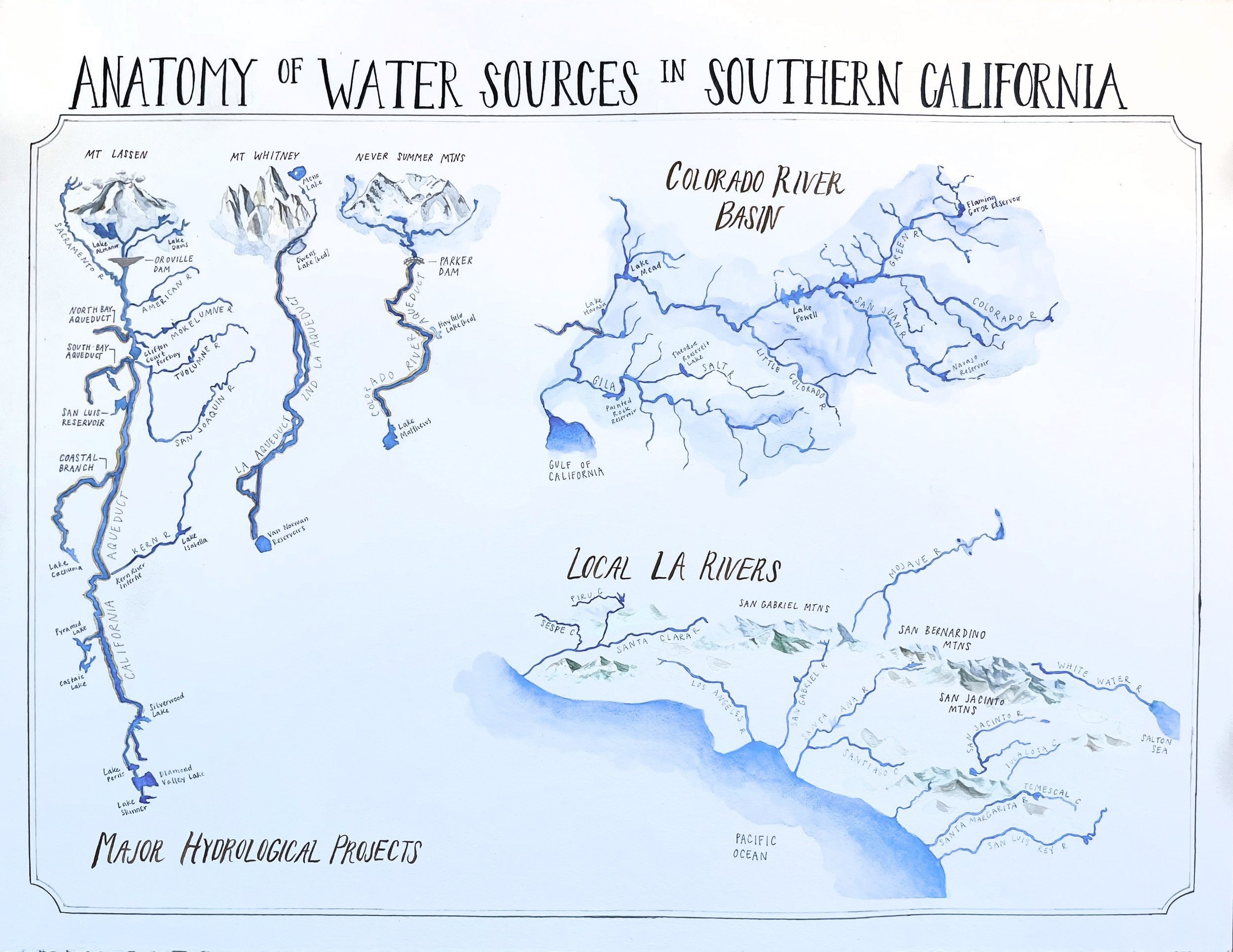
State Water Project: California Aqueduct
While the SWP produces hydropower, it is also the largest consumer of power in California with a net usage of 5,100 GWh.
Length: 705 miles
Supply: Dependent on allocation
| Infrastructure | Uses |
| 34 reservoirs and lakes 701 miles of aqueducts 5 power plants 24 pumping plants | 27 million people residential, municipal, industrial (66%) 750,000 acres farmland (34%) 6,500 GWh hydroelectric power annually |
Southern California has a history of expanding its capacity for population growth through hydrological projects that extract water from distant watersheds. While the entire state of California is about 104 million acres, the City of Los Angeles alone accesses over 140 million acres of watershed area to supply water to its residents and businesses. Southern California is in a state of "ecological debt"--but it's a debt that is never paid back. Despite a three-fold increase in population, water savings measures such as low-flow toilets and showerheads, lawn replacements, and water catchment systems have limited water use increases, which, ironically, have occurred most recently during times of severe drought.
Los Angeles Aqueduct(s)
Owens Lake has remained (mostly) dry since the inception of the LA Aqueduct, requiring Los Angeles Department of Water and Power to spend over $1 billion in attempts to prevent the lakebed's dust from affecting the respiratory health of locals.
Length: 460 miles
Supply: 260 million gallons daily
| Infrastructure | Uses |
| 34 reservoirs and lakes 701 miles of aqueducts 5 power plants 24 pumping plants |
27 million people residential, municipal, industrial (66%) 750,000 acres farmland (34%) 6,500 GWh hydroelectric power annually |
Colorado River Aqueduct (California)
While California is legally entitled to 4.4 million acre feet of the Colorado River, the state has historically drawn more than its allotment. The effort to bring water from the river westward has not occured without environmental casualties. An engineering mistake in 1905 caused water from the Colorado river to breach an irrigation canal and create the Salton Sea. Further, instead of pumping water over or around Mount San Jacinto, a tunnel was blasted directly through such that water flows underneath the mountain with a seemingly unrestrainable flow that has periodically project water into various directions within the mountain.
Length: 242 miles
Supply: 1 Billion gallons daily
| Infrastructure | Uses |
| 150 miles of canals 5 pumping plants 90 miles of tunnels | Municipal |
The Colorado River Basin
The Colorado River Basin, spanning around 246,000 square miles, is one of the most heavily developed basins in the world. Around 80% of the water supply is replenished by snowmelt each year; however, aridification is posing a threat to this supply, as snowpacks decrease and evaporation increases. The over-allocation of its waters have also put serious strain on the water storage of the basin, as it is shared by seven states (Colorado, New Mexico, Utah, Wyoming, Arizona, Nevada and of course, California) all with different water politics. The Colorado River is also the source of a longstanding dispute between the United States and Mexico. The river no longer drains at the Gulf of Mexico, as the flow is dry after the dam at the US-Mexico border.
Length: 1450 miles
| Dams | Uses |
| 15 along main river hundreds along tributariess |
40 million people served |
Local LA Rivers
Southern California's local rivers, streams and creeks were originally used by Indigenous groups, with many villages being built along prominent rivers. Multiple rivers and creeks stll exist in Southern California, many of them have been "altered"--meaning that waterways are controlled, paved, shifted, and changed. Manh of our native rivers and creeks flowed seasonally, shifting to underground for parts of the year. Local water can't supply enough water to serve the region's needs, although familar water company names such as Yosemite (named for Yosemite Avenue in Highland Park, not for Yosemite National Park) and Sparkletts still bottle and sell local water. To date, there is no reliable inventory of how much water Southern California has on its own. Many creeks are channelized and indistiguishable from storm drains--where the water flows uselessly to "water the ocean," as Jenny Price once put it. These rivers are the underrepresented water sources of Southern California.
| River | Length (miles) |
| Mojave River | 110 |
| Santa Ana River | 96 |
| Santa Clara river | 83 |
| San Gabriel River | 58 |
| Whitewater river | 54 |
| LA River | 51 |
| San Jacinto River | 42 |
| Santiago Creek | 34 |
| Santa Gertrudis Creek (Tucalota creek) | 24 (estimate) |
| San Margarita River | 30 |
| Temescal Creek | 29 |
| San Juan River | 29 |
| Arroyo Seco | 25 |
| San Dieguito River | 24 |
| Arroyo Trabuco | 22 |
| San Mateo Creek | 22 |
| Aliso Creek | 20 |
Zanjas
Zanjas were the premier water system for El Pueblo de Los Angeles from the late 1700's to early 1900's, established by Spanish colonizers and the residing Indigenous groups. The Zanja Madre was the original aqueduct that supplied water to Angelinos residents and farmers. The Zanja Madre was collectively built and diverted water from what was at that time known as the Río de Porciúncula (LA River). In addition the Zanja Madre, there came to be nearly a hundred zanjas in and around the Los Angeles area, built and largely controlled by the hands of Angelenos themselves. Even then, conflict over the water in these ditches was ripe and sometimes violent. The Zanjero, a revered importante official, was the overseer of the water system who often patrolled the zanjas with a shovel in hand to remediate issues on the spot. In the late 1800's, European American ideals of closed and purportedly cleanlier water pipe systems began competing with the open air-open access ditches championed by Mexican American values of community. Eventually, the area's population and sanitation needs outgrew the zanja system completely.
Reducing our Debt
Overreliance on water resources from outside of Southern California creates a situation of “ecological debt.” Essentially, this means we are living beyond our means—a problem we have solved by taking water from other regions. Water challenges aren’t exclusive to Southern California. Increasingly, So Cal water sources from a variety of locations are also changing. But cities like Los Angeles have goals to reach 100% local water through water capture, water recycling, and water conservation. Go LA!
The Color of Water
Did you know that there are many different kinds of water? Some colors (green, blue, grey, black, and purple, below) are how we designate water types. Other color terms (red, orange, yellow, even pea soup!) are reflective of off-color water due to algal blooms or a high presence of minerals like iron.
Flip the color boxes below to find out how some of the colors of water are connected and others are connected to climate change and out-of-whack ecosystems.
Adelanto: Water Justice in the High Desert
More of our favorite water projects…
- LA Creek Freak: https://lacreekfreak.wordpress.com
- Take Me To Your River: https://clockshop.org/project/take-me-to-your-river
- Metabolic Studio: https://www.metabolicstudio.org/about
- Beyond the LA River: https://www.hiddenhydrology.org/beyond-the-la-river
- LA River X: https://www.lariverx.net
Contact Us to add your favorite project here!